Cameroonian companies paying foreign suppliers: documents, delays and planning
A Yaoundé distributor paying a supplier in China, Türkiye or France needs documents in order before its bank sends the transfer. Under CEMAC rules, transfers above thresholds need justification, and processing can take longer than suppliers expect.
- Published
- Reading time
- 1 min read
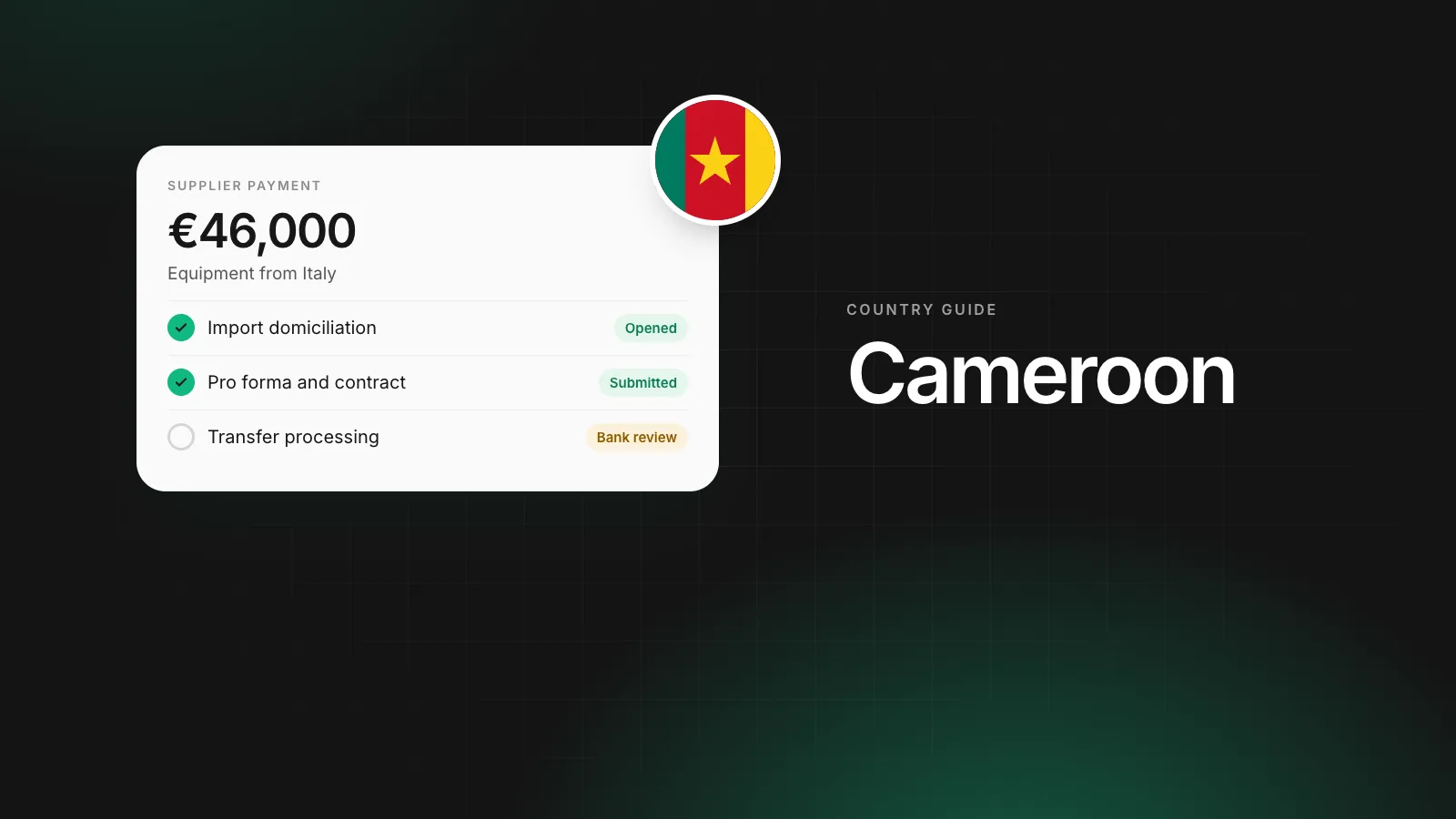
A Yaoundé medical equipment distributor orders €46,000 of devices from Italy. Before the supplier ships, it wants payment. The distributor opens an import domiciliation with its bank, submits the pro forma invoice and contract, and waits while the bank reviews the file and executes the transfer. Eight days pass. The supplier ships late.
How import payments work
Under the CEMAC exchange regulation, imports above thresholds are domiciled with a bank. The bank follows the transaction, checks the documents and executes the payment abroad. Transfers must be justified with documents.
The documents
- Pro forma or commercial invoice.
- Contract or purchase order.
- Import declaration and customs documents, once the goods arrive.
- Any licences required for the product.
Submit them complete. Missing documents are the main cause of delays.
Planning
Suppliers abroad often want payment before shipping, and Cameroonian banks need time. Plan payments a week or two ahead of the supplier's deadline. For regular suppliers, agree terms that allow for processing time.
Currencies
The XAF is pegged to the euro, so euro suppliers carry no exchange rate risk. Chinese suppliers in dollars or yuan, and Turkish suppliers in dollars, do. Compare prices in euros where suppliers offer them.
GUCE
Cameroon's single window for foreign trade, the GUCE, handles many import formalities online. Use it to speed up the customs side.
Paying into Cameroon: the local rail
| What | Detail |
|---|---|
| Local rail | SYSTAC batch clearing and SYGMA real-time gross settlement; GIMAC for transfers between banks and mobile money |
| Run by | Banque des États de l'Afrique Centrale (BEAC); GIMAC |
| Settlement | SYSTAC the same or next business day; GIMAC transfers in minutes |
Source: BEAC: payment systems. Checked when this guide was last updated; the scheme's own page has the current figures.
Where Rivet fits
Rivet opens business accounts for registered companies after verification. Cameroon-registered companies should follow CEMAC rules and their bank's procedures for import payments and accounts abroad. Rivet is not a bank; regulated partner institutions hold the funds.
Questions people ask
What is import domiciliation?
Registering an import transaction with a bank, which then follows the documents and executes the payment under the exchange regulation.
Why do supplier payments from Cameroon take long?
Banks review documents under CEMAC rules and may need to source foreign currency. Incomplete files are the main cause of delay.
How can companies avoid delays?
Submit complete documents early, plan payments before suppliers' deadlines and keep a good relationship with the bank's foreign operations team.
Is the euro a risk for Cameroonian importers?
No. The XAF is pegged to the euro. Dollar and yuan prices move against the franc.
Sources
Rashidatou writes Rivet's guides to how money moves between countries: the payment rails, what each one costs, and the account details a company needs to get paid in another currency. Every figure in Rashidatou's articles is traced to the scheme rulebook, the regulator or the provider's published price list, and those sources are listed at the end.
More from Rashidatou K. →This article is general information, not legal, tax or financial advice. Rules and fees change; check the sources above and the provider’s current terms before you act on them.
- cameroon
- imports
- suppliers
- beac
- domiciliation
- xaf