US companies paying foreign contractors: W-8BEN, no 1099, and when withholding applies
When a US company pays a developer in Poland or a designer in Argentina, the paperwork is different from paying an American freelancer. There is no W-9 and usually no 1099. There is a W-8 form, and a short list of cases where withholding does apply.
- Published
- Reading time
- 2 min read
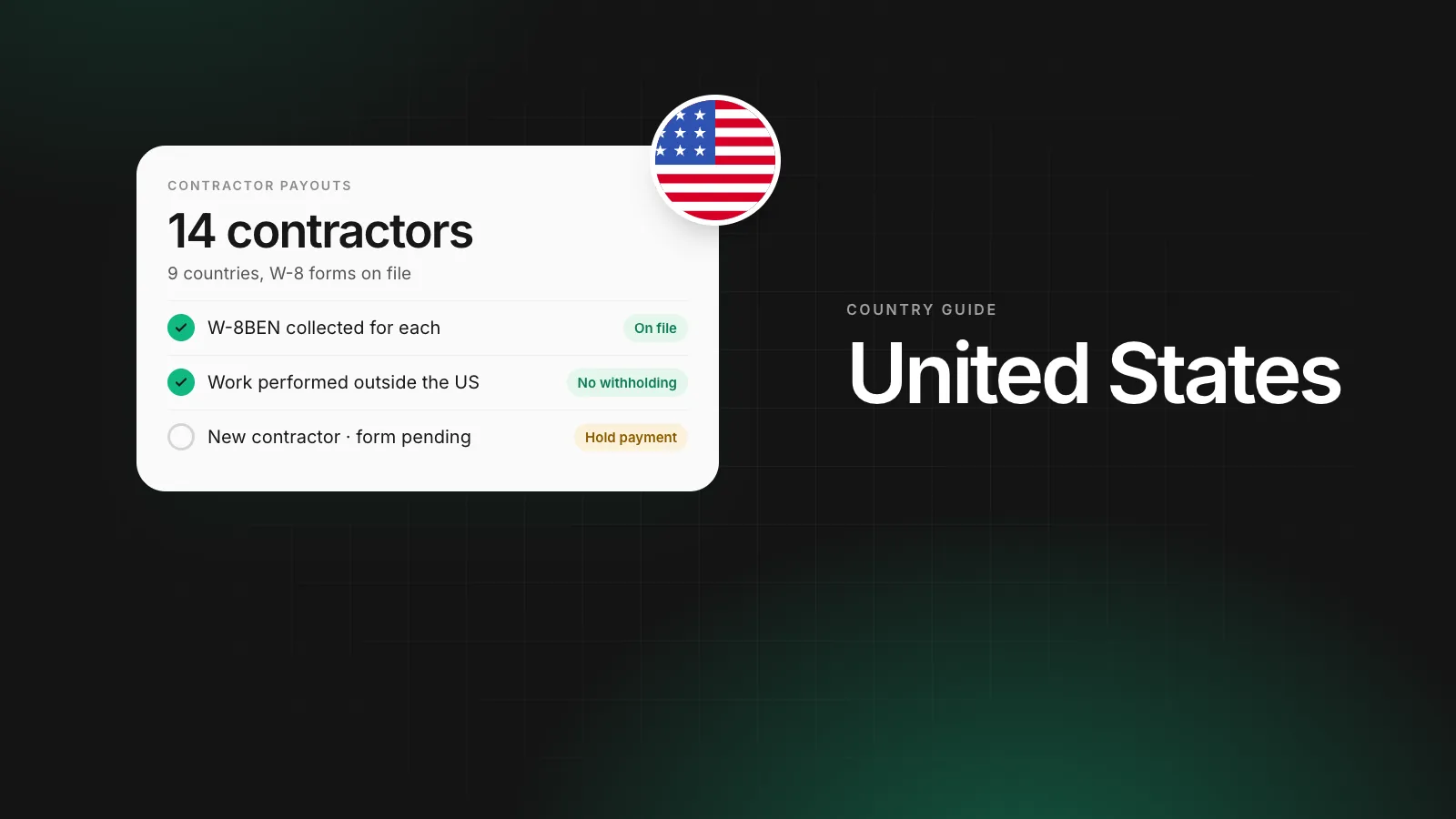
An Austin startup pays 14 contractors in nine countries. Its bookkeeper, used to American freelancers, asks each for a W-9 and plans to send 1099-NECs in January. Neither is right. Foreign contractors fill in a W-8 form, and for work done outside the US, no 1099 goes out.
The right form
- Form W-8BEN for a foreign individual contractor.
- Form W-8BEN-E for a foreign company, such as a contractor's own limited company.
The form certifies that the contractor is not a US person and, where relevant, claims treaty benefits. Collect it before the first payment and keep it on file. It generally stays valid until the end of the third calendar year after signing, unless something changes.
Source of income decides withholding
US tax on payments to foreign persons depends largely on where the income comes from. For services, that means where the work is performed.
- Work performed outside the US: foreign-source income. No US withholding, no 1099, nothing to report on Form 1042-S for that payment.
- Work performed in the US, for example during a visit to your office: US-source income. It can be subject to 30 percent withholding, reported on Form 1042-S, unless a tax treaty exempts it.
Track any time contractors spend working in the US.
Classification
A contractor in another country can still be found to be an employee, under that country's rules. Full-time, exclusive, directed work over years is the pattern that triggers it. Contracts with deliverables, contractors using their own tools and setting their own hours, and invoices rather than fixed salaries are the usual safeguards. Some companies use an employer of record for people who are effectively staff.
Paying them well
A dollar wire to a contractor abroad is converted by their bank, often with a receiving fee, and can take days. Paying in their local currency on a local rail delivers the invoiced amount, usually faster. For contractors in countries with volatile currencies, dollars to an account they control may be what they prefer. Ask, and write it in the contract.
Paying into the United States: the local rail
| What | Detail |
|---|---|
| Local rail | ACH for batch payments; RTP and FedNow for instant transfers |
| Run by | Nacha for ACH; The Clearing House for RTP; the Federal Reserve for FedNow |
| Settlement | Same-day ACH within the business day, standard ACH the next; RTP and FedNow in seconds, 24/7, where both banks take part |
Source: Nacha: Same Day ACH. Checked when this guide was last updated; the scheme's own page has the current figures.
Where Rivet fits
A Rivet business account pays contractors in 120+ countries, in local currency on local rails where available or in dollars where preferred. Bulk payouts send the month's invoices together, each payment shows its rate before you confirm, and from the Growth plan a second approver can be required. Rivet is not a bank; regulated partner institutions hold the funds.
See also W-8BEN vs W-8BEN-E and Form 1099-NEC thresholds.
Questions people ask
Do I send a 1099-NEC to a foreign contractor?
Generally no. Form 1099-NEC is for US persons. For a foreign contractor who provides a valid W-8BEN or W-8BEN-E and works outside the US, no 1099 is required.
When does a US company withhold tax from a foreign contractor?
When the payment is US-source income, mainly for services performed in the US, and no treaty exemption applies. Withholding is reported on Form 1042-S.
How long is a W-8BEN valid?
Generally until the end of the third calendar year after it is signed, unless a change in circumstances makes it incorrect earlier.
Can a foreign contractor be misclassified?
Yes. Classification rules in the contractor's country, and US rules if they work in the US, can treat a long-term, controlled relationship as employment.
Sources
William covers what happens once a company starts moving money: getting the business verified, paying contractors and suppliers abroad, and keeping card spend under control. William writes for the founder or finance lead who has to make it work this week, and links every rule cited to the text it comes from.
More from William Sunjo M. →This article is general information, not legal, tax or financial advice. Rules and fees change; check the sources above and the provider’s current terms before you act on them.
- us
- foreign contractors
- w-8ben
- 1099
- withholding
- payouts