Selling to EU customers from a UK company: VAT, IOSS and getting paid in euros
Since January 2021 a UK company selling into the EU is a non-EU seller. Services to EU businesses mostly fall under the reverse charge, consumer sales can mean EU VAT registration, and euro customers expect an IBAN they can pay by SEPA.
- Published
- Reading time
- 3 min read
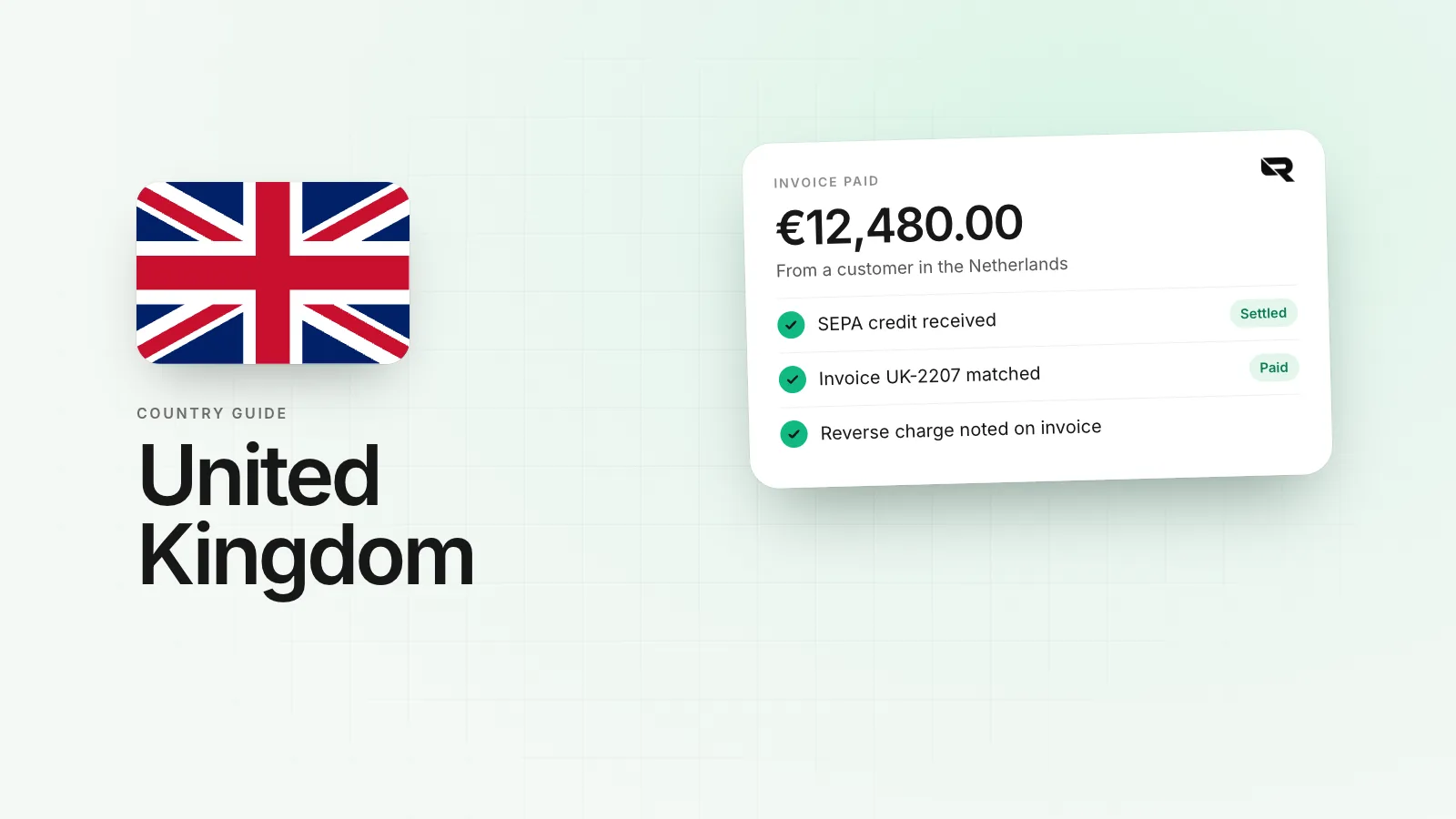
A design studio in Manchester invoices a client in Rotterdam for £10,000 worth of work. Before 2021 that was an intra-EU supply. Today the studio is a non-EU business selling into the EU, and three questions follow: does the invoice carry VAT, who pays it, and how does the euro payment arrive.
Services to EU businesses: the reverse charge
For most business-to-business services, VAT follows the customer. The Dutch client belongs in the Netherlands, so the supply is taxed there, and the client accounts for Dutch VAT itself under the reverse charge. The studio's invoice shows no UK VAT and says the reverse charge applies.
Get the customer's VAT number and keep it on file. It is your evidence that you sold to a business and not a consumer, and HMRC can ask for it.
A few services are taxed where they are performed or where land sits, such as event admission and work on property. Check the place-of-supply rules before you assume the general rule fits.
Sales to EU consumers
Consumer sales are where UK companies get caught out.
- Digital services such as software subscriptions, online courses and streamed content are taxed in the consumer's EU country from the first euro. The usual route is to register for the non-Union One Stop Shop in one EU state and file one quarterly return for all of them.
- Goods up to €150 per consignment can go through the Import One Stop Shop (IOSS). You charge EU VAT at checkout, quote your IOSS number on the parcel, and the customer pays nothing more on delivery.
- Goods above €150 pay import VAT and any duty at the border. If you ship on terms where the customer pays, expect refused parcels from people who did not know.
The EU is also removing the customs duty exemption for low-value parcels, so check the current position before you price small shipments.
Getting paid in euros
Most EU customers pay suppliers by SEPA credit transfer. It is cheap and, with SEPA Instant now standard in the euro area, often arrives in seconds. SEPA needs a euro IBAN at the receiving end.
Give a Dutch client sterling account details and their bank sends an international transfer instead. The money is converted at the bank's rate, can lose a fee to an intermediary on the way, and lands short of the invoice. Someone then chases a few pounds of difference across two finance teams.
Holding a euro account fixes this, and it does something else: you choose when to convert. A company that also pays EU suppliers or contractors in euros may not need to convert most of it at all.
Paying into the United Kingdom: the local rail
| What | Detail |
|---|---|
| Local rail | Faster Payments |
| Run by | Pay.UK |
| Settlement | Seconds, 24/7; the scheme limit is £1,000,000, and each bank sets its own |
Bacs still carries most payroll and Direct Debits, on a three-day cycle.
Source: Pay.UK: Faster Payment System. Checked when this guide was last updated; the scheme's own page has the current figures.
Where Rivet fits
A Rivet business account on the Growth plan gives a UK limited company euro account details with an IBAN for SEPA and sterling details for Faster Payments, plus US dollar details for ACH and wires, all in the company's own name. Balances can be held, converted at a rate shown before you confirm, and paid out to 120+ countries. Rivet is not a bank; regulated partner institutions hold the funds.
For the invoice itself, read our guide to EU VAT OSS for non-EU sellers before your first consumer sale.
A checklist before the next EU invoice
- Confirm whether the customer is a business and record its VAT number.
- Check the place-of-supply rule for the service you sell.
- Add the reverse charge wording to the invoice where it applies.
- Decide whether consumer sales need OSS or IOSS registration.
- Put euro bank details with an IBAN on the invoice.
Questions people ask
Does a UK company charge UK VAT to EU business customers?
For most services, no. The place of supply is where the business customer belongs, so the invoice shows no UK VAT and states that the customer accounts for VAT under the reverse charge. Goods are different: exports leave the UK zero rated and the EU buyer deals with import VAT.
When does a UK seller need IOSS?
IOSS covers goods in consignments worth up to €150 sold to EU consumers. Registering lets you charge EU VAT at checkout so the parcel clears without the customer paying VAT on delivery. Above €150, import VAT is collected at the border.
Can EU customers pay a UK company by SEPA?
Only into a euro account with an IBAN that can receive SEPA credits. Paid to a sterling account, the same money travels as an international transfer, with conversion and often intermediary fees.
Do I need an EU entity to sell to EU customers?
No. Many UK companies sell into the EU directly. An EU entity becomes worth considering when stock is held in the EU, when local staff are hired, or when customers insist on an EU supplier.
Sources
William covers what happens once a company starts moving money: getting the business verified, paying contractors and suppliers abroad, and keeping card spend under control. William writes for the founder or finance lead who has to make it work this week, and links every rule cited to the text it comes from.
More from William Sunjo M. →This article is general information, not legal, tax or financial advice. Rules and fees change; check the sources above and the provider’s current terms before you act on them.
- uk
- eu vat
- ioss
- reverse charge
- sepa
- eur account