Invoicing clients abroad from a Spanish SL: the ROI, modelo 349 and VAT wording
A Spanish SL that sells services to a company in France or Germany needs a valid EU VAT number, which in Spain means registering in the Registro de Operadores Intracomunitarios. Without it the client cannot apply the reverse charge, and the invoice turns into a problem.
- Published
- Reading time
- 3 min read
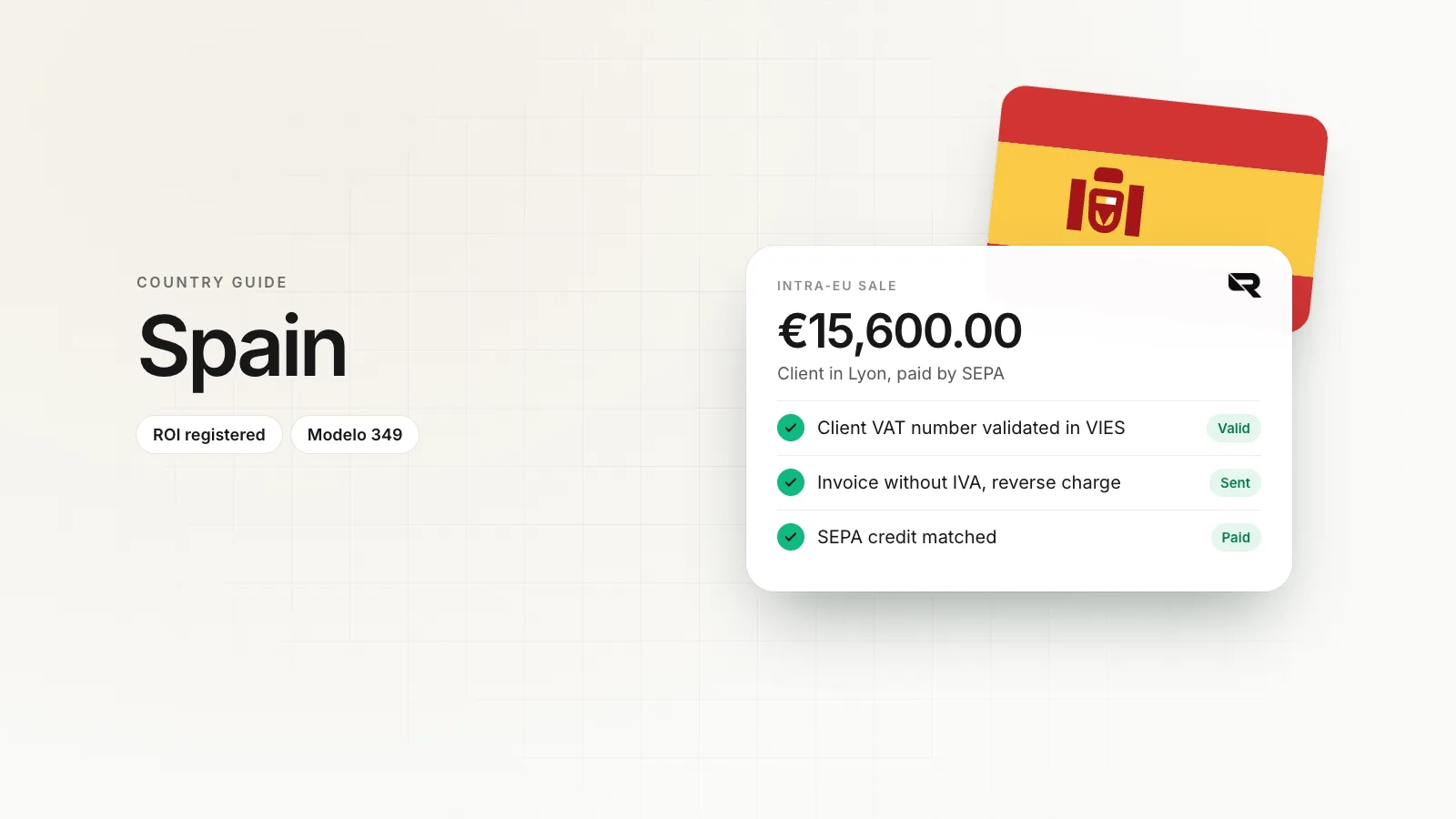
A Valencia marketing agency wins its first French client, a retailer in Lyon. The agency sends a €15,600 invoice without IVA, as it has read it should. The French client's accounts team checks the agency's VAT number in the EU's VIES database. It comes back invalid, and the invoice goes on hold.
The agency has a NIF. It simply never registered in the ROI.
The ROI: the step most new SLs skip
A Spanish company's NIF works for domestic tax. To be recognised as a VAT number for trade with other EU countries, the company has to be registered in the Registro de Operadores Intracomunitarios (ROI). The application goes through modelo 036 and the Agencia Tributaria can ask for evidence of real activity before approving it.
Once registered, the number validates in VIES with the prefix ES. Check that yours does before sending the first EU invoice. Check your client's too, and keep a screenshot of the result with the invoice.
Invoicing EU business clients
For most services to businesses in another EU country, the place of supply is where the client is established. The invoice:
- shows no Spanish IVA,
- carries both companies' VAT numbers,
- states that the reverse charge applies (inversión del sujeto pasivo), with the legal reference.
The client then accounts for VAT in its own country.
The modelo 349
Every intra-EU sale and purchase is also declared in the modelo 349, a recapitulative statement listing each counterparty's VAT number and the total for the period. Most companies file monthly once they have regular EU activity. The amounts must match your IVA returns and your clients' declarations in their countries, which tax authorities cross-check.
Clients outside the EU
Services to a business in the US, the UK or Mexico are generally not subject to Spanish IVA. The invoice states the reason and cites the article of the IVA law that applies. They do not go in the modelo 349.
Getting paid
French and German clients pay a Spanish IBAN by SEPA in seconds. Clients outside the euro area are slower. A US client asked to pay a Spanish IBAN has to send an international wire, which often arrives short after an intermediary fee and is converted at the receiving bank's rate. A UK client pays more easily into sterling details.
Paying into Spain: the local rail
| What | Detail |
|---|---|
| Local rail | SEPA Instant Credit Transfer (Bizum for mobile transfers) |
| Run by | European Payments Council scheme, run by each bank |
| Settlement | Under ten seconds, 24/7 |
| Published fee | By the EU Instant Payments Regulation, no more than the bank charges for a standard SEPA transfer |
Source: European Payments Council: SEPA Instant Credit Transfer. Checked when this guide was last updated; the scheme's own page has the current figures.
Where Rivet fits
Rivet does not file the modelo 349 or register you in the ROI; that is for you and your gestor. A Rivet business account handles the payment side for foreign clients: US account details in the SL's own name on every plan, so American clients pay by ACH, plus euro and sterling details from the Growth plan. Payments are matched to invoices and balances can be held or converted at a rate shown before you confirm. Rivet is not a bank; regulated partner institutions hold the funds.
For consumer sales across the EU, see EU VAT OSS for non-EU sellers, whose OSS rules apply to Spanish sellers too through the Union scheme.
Questions people ask
What is the ROI in Spain?
The Registro de Operadores Intracomunitarios is the register of companies authorised to carry out intra-EU transactions. Registration, made through modelo 036, activates the company's NIF as a VAT number in the EU's VIES database.
What happens if my SL is not in the ROI?
Your VAT number will not validate in VIES, so an EU business client cannot apply the reverse charge. In principle you would have to charge Spanish IVA, which the client may refuse to pay.
Who files the modelo 349?
Companies that carry out intra-EU deliveries of goods, services to EU businesses or intra-EU acquisitions. It lists each counterparty's VAT number and the total amount for the period.
Do I charge IVA to a US client?
For most services to a business established outside the EU, no: the place of supply is where the client is. The invoice states that the operation is not subject to Spanish IVA and cites the article that applies.
Sources
William covers what happens once a company starts moving money: getting the business verified, paying contractors and suppliers abroad, and keeping card spend under control. William writes for the founder or finance lead who has to make it work this week, and links every rule cited to the text it comes from.
More from William Sunjo M. →This article is general information, not legal, tax or financial advice. Rules and fees change; check the sources above and the provider’s current terms before you act on them.
- spain
- sl
- roi
- modelo 349
- reverse charge
- iva