Slovenian companies selling to Serbia, Bosnia and North Macedonia: currencies and payment risk
For many Slovenian manufacturers and distributors, the Western Balkans are a home market with borders. Buyers there are outside the EU, pay in several currencies and sometimes on long terms. A few habits make collections more predictable.
- Published
- Reading time
- 2 min read
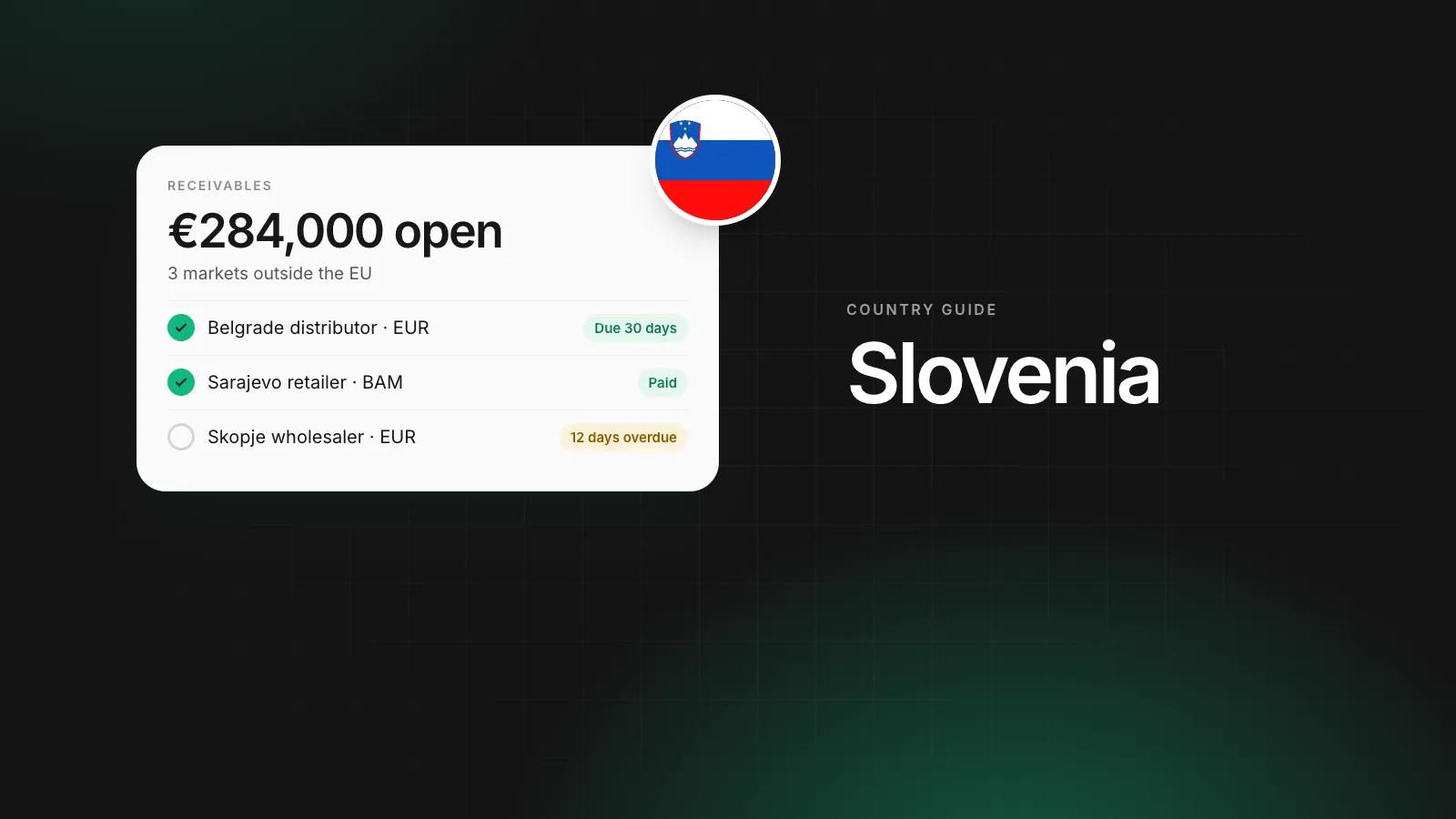
A Celje household appliance distributor sells across the former Yugoslavia. Its Belgrade distributor pays euros on 30-day terms, mostly on time. Its Sarajevo retailers prefer to pay in convertible marks. A Skopje wholesaler pays euros, usually late. Together the three markets are a quarter of revenue and half of the overdue receivables.
Outside the EU
Serbia, Bosnia and Herzegovina and North Macedonia are candidate countries, not members. Goods shipped there are exports: export declarations in Slovenia, import clearance and local VAT on arrival. Most industrial goods move duty-free under the EU's agreements with these countries, provided origin rules are met.
Services to businesses in the region are generally outside Slovenian VAT, and the invoice states so.
Currencies
- Euro: common in contracts and import invoices throughout the region.
- Bosnian convertible mark (BAM): pegged to the euro by a currency board. Little rate risk, but conversion still costs.
- Serbian dinar (RSD): managed by the National Bank of Serbia, not fixed.
- Macedonian denar (MKD): closely managed against the euro.
Local foreign exchange rules can affect how buyers pay in foreign currency, especially for advance payments. Ask buyers what they can pay and how, before you set terms.
Managing payment risk
Payment delays in the region usually follow from weak cash flow at the buyer, not refusal. Practical controls:
- Credit limits per buyer, reviewed each quarter.
- Advance payment for new buyers until a history exists.
- Local credit checks through business registers and credit agencies.
- Export credit insurance for the largest exposures.
- Clear late-payment terms on the contract, with interest.
Collecting
Euro payments from the region reach a Slovenian IBAN directly when the buyer's bank sends them as SEPA transfers; several Western Balkan countries have joined or are joining the SEPA schemes, and banks that have not send international transfers with fees. Local currency payments from Bosnian retailers are converted somewhere along the way. Ask your buyers which route costs them least, and fix who pays charges in the contract.
Paying into Slovenia: the local rail
| What | Detail |
|---|---|
| Local rail | SEPA Instant Credit Transfer |
| Run by | European Payments Council scheme, run by each bank |
| Settlement | Under ten seconds, 24/7 |
| Published fee | By the EU Instant Payments Regulation, no more than the bank charges for a standard SEPA transfer |
Source: European Payments Council: SEPA Instant Credit Transfer. Checked when this guide was last updated; the scheme's own page has the current figures.
Where Rivet fits
A Rivet business account gives a Slovenian company euro details with an IBAN from the Growth plan and US dollar details on every plan, and on the Scale plan balances in 30 currencies. Payments are matched to invoices and conversions happen at a rate shown before you confirm. Rivet is not a bank; regulated partner institutions hold the funds.
Questions people ask
Do Western Balkan buyers pay in euros?
Many do, especially for imports, and contracts are often in euros. Some buyers, particularly smaller retailers, prefer to pay in local currency.
Is VAT charged on sales to Serbia?
Exports of goods from Slovenia to Serbia are zero-rated with customs evidence. Services to Serbian businesses are generally outside Slovenian VAT. Serbia applies its own VAT at import.
How can I reduce payment risk in the region?
Set credit limits per buyer, take advances from new buyers, check buyers through local credit registers, and consider export credit insurance.
Is the Bosnian mark a currency risk?
Very little against the euro, because of its currency board peg. The cost is mainly conversion margins and fees.
Sources
Rashidatou writes Rivet's guides to how money moves between countries: the payment rails, what each one costs, and the account details a company needs to get paid in another currency. Every figure in Rashidatou's articles is traced to the scheme rulebook, the regulator or the provider's published price list, and those sources are listed at the end.
More from Rashidatou K. →This article is general information, not legal, tax or financial advice. Rules and fees change; check the sources above and the provider’s current terms before you act on them.
- slovenia
- serbia
- bosnia
- north macedonia
- rsd
- bam