Revolut Business vs Mercury for US companies
Revolut Business sells an FX allowance inside each plan. Mercury sells free USD wires. If your company converts a steady amount each month, Revolut's model can win; if it spikes, it can cost more.
- Published
- Updated
- Reading time
- 2 min read
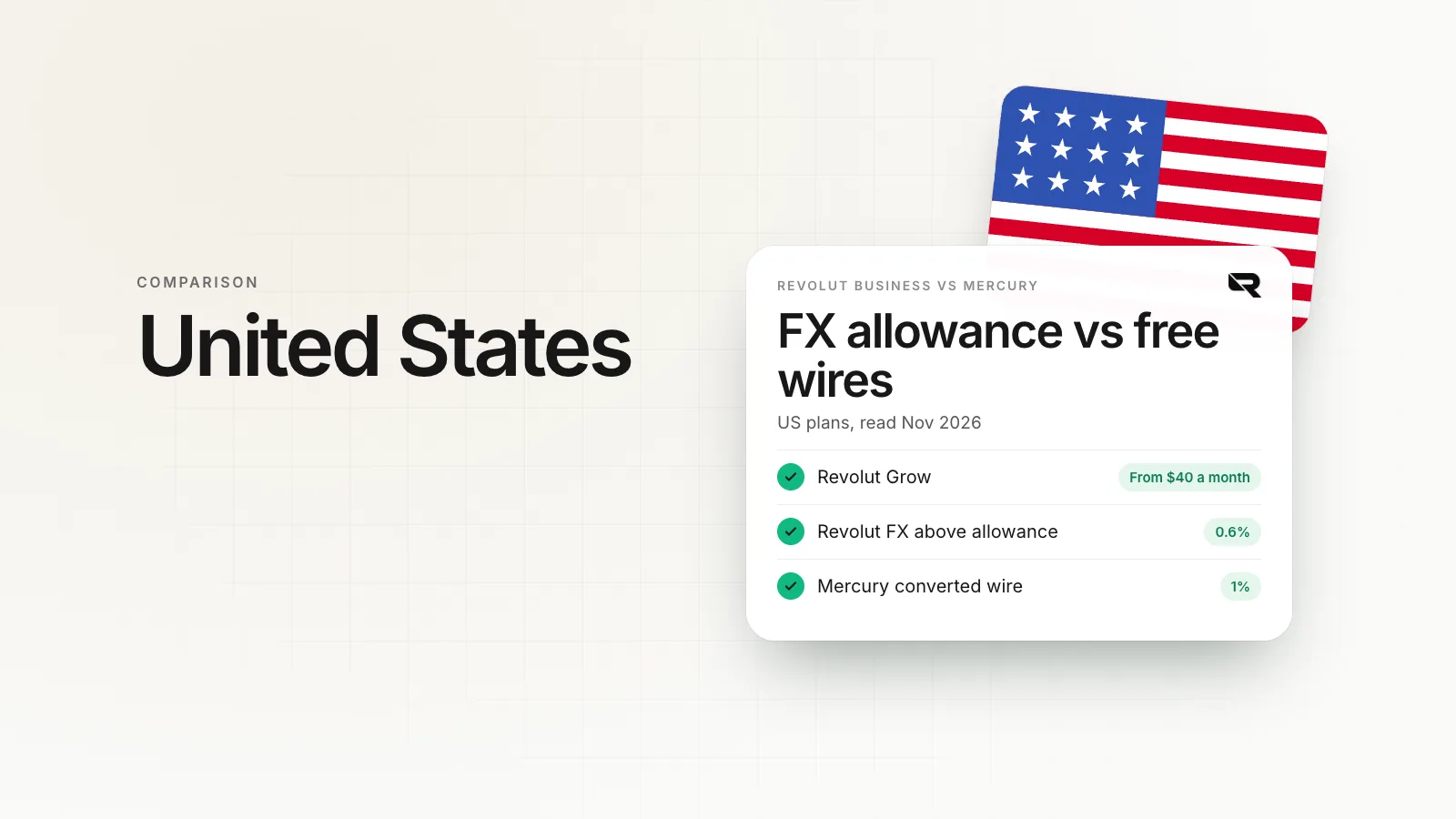
Revolut Business and Mercury price international money in opposite ways. Revolut puts an amount of cheap FX inside each plan. Mercury makes USD wires free and charges a flat 1% when it converts. Figures below come from Revolut's US plans page (read on 1 November 2026) and Mercury's pricing page (read on 4 November 2026).
The plans
| Revolut Basic | Revolut Grow | Revolut Scale | Mercury | |
|---|---|---|---|---|
| Monthly | From $10 | From $40 | From $140 | $0 base |
| Interbank FX allowance | $1,000 | $20,000 | $80,000 | None; 1% per converted wire |
| Free international transfers | 0 | 5 | 25 | USD wires $0 |
Above the allowance, Revolut charges 0.6% (1% outside market hours). Extra international transfers cost $5 each.
Three companies, three answers
- A design agency converts $15,000 a month to pay European freelancers. Revolut Grow covers it inside the allowance for $40. Mercury charges about $150. Revolut wins.
- A SaaS company converts $150,000 a month. Revolut Scale covers $80,000; the other $70,000 at 0.6% costs $420, plus the plan. Mercury charges about $1,500. Revolut wins clearly.
- A US services firm pays US contractors by wire and never converts. Mercury costs nothing. Revolut adds a plan fee for no benefit.
What to watch
Revolut's model punishes the wrong plan. A company that sits on Grow and has one heavy month pays 0.6% on the excess. Review your plan quarterly against actual volumes.
Paying into the United States: the local rail
| What | Detail |
|---|---|
| Local rail | ACH for batch payments; RTP and FedNow for instant transfers |
| Run by | Nacha for ACH; The Clearing House for RTP; the Federal Reserve for FedNow |
| Settlement | Same-day ACH within the business day, standard ACH the next; RTP and FedNow in seconds, 24/7, where both banks take part |
Source: Nacha: Same Day ACH. Checked when this guide was last updated; the scheme's own page has the current figures.
Where Rivet fits
Rivet keeps the pricing flat. Starter is free with USD details and FX from 0.80%. Growth ($200) adds EUR and GBP details, local payouts in 120+ countries and FX from 0.50%. Scale ($500) adds 25 more currencies and FX from 0.30%. There is no allowance to outgrow, and the rate shows before you confirm. Rivet is not a bank; regulated partner institutions hold the funds. See Revolut Business alternatives.
Questions people ask
Is Revolut Business available in the US?
Yes. Revolut publishes US business plans, with prices and allowances that differ from its UK and EU plans.
What happens when I go over Revolut's FX allowance?
Each conversion above the plan's monthly allowance costs 0.6%, or 1% outside market hours. That is still below Mercury's 1%, but a heavy month on a small plan can cost more than the next plan up would have.
Which has better cards?
Mercury offers debit and an IO credit card with cash back. Revolut offers debit cards with spend controls. Neither charges per card in the base plans.
Which suits a company with foreign owners?
Both are aimed at US-registered companies. Rules for owners living abroad vary; check each provider's eligibility page.
Sources
Alexia compares the accounts, cards and payment tools companies weigh before they switch, and writes Rivet's market guides for founders in a specific country. Prices in Alexia's comparisons come from each provider's own pricing page on the date given in the article, rules come from the regulator or tax authority that sets them, and every source is listed at the end.
More from Alexia M. →This article is general information, not legal, tax or financial advice. Rules and fees change; check the sources above and the provider’s current terms before you act on them.
- revolut business vs mercury
- revolut business us
- mercury bank
- fx allowance
- comparison