Latvian timber and wood product exporters: payment terms, currencies and getting paid
Sawn timber, plywood, pellets and furniture make wood Latvia's biggest export sector. Buyers in the UK, Scandinavia, Germany and Asia pay in different currencies and on different terms, and the exporter carries the risk while the cargo is at sea.
- Published
- Reading time
- 2 min read
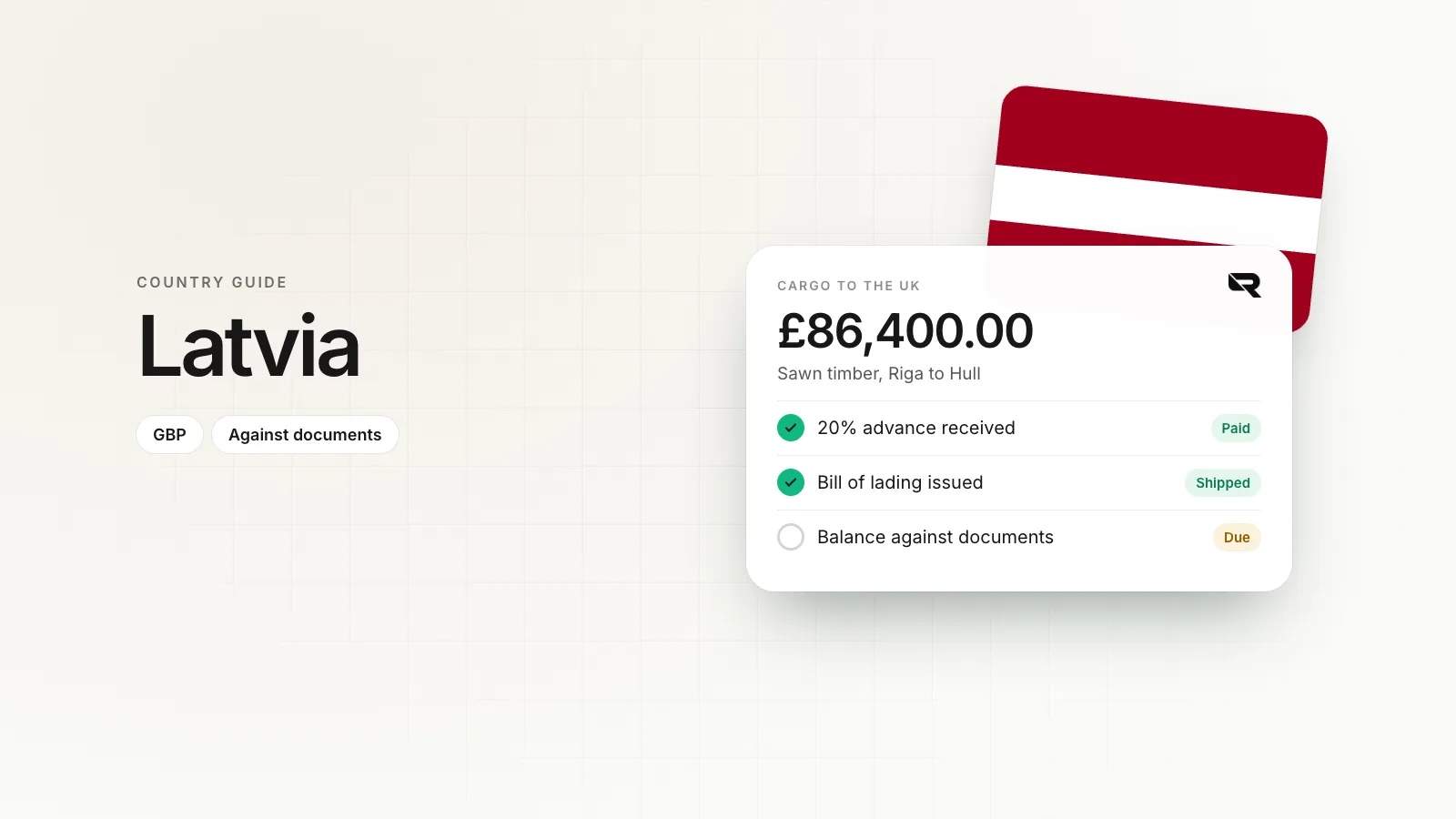
A sawmill near Jelgava ships sawn spruce from Riga to Hull, plywood to Rotterdam and pellets to Copenhagen. Its UK buyer contracts in pounds, its Japanese buyer in dollars, its Danish buyer in euros. Every cargo leaves before it is fully paid, and the mill's euro account converts each foreign payment the day it arrives.
Who buys and how they pay
The UK, Sweden, Denmark, Germany and the Netherlands are among the largest buyers of Latvian wood products, with Asian buyers important for some grades. Payment habits differ:
- UK merchants often contract in pounds, with an advance and the balance against documents or on short terms.
- Nordic and German buyers usually pay euros, often on 30-day terms after delivery.
- Asian buyers often pay in dollars, sometimes under letters of credit.
Protecting the cargo
A shipload of timber is a large exposure to one buyer. Three structures reduce it:
- Advance payment. A share, often 10 to 30 percent, on order confirmation.
- Cash against documents. The buyer receives the bill of lading, which it needs to collect the cargo, only after paying the balance.
- Letter of credit. The buyer's bank commits to pay when you present compliant documents. It costs more and needs careful paperwork. See letter of credit explained.
Pounds and dollars into a euro business
The mill's costs, including roundwood, staff, energy and transport, are almost all in euros. Foreign revenue has to be converted at some point. The question is when, and at what rate.
Converting each payment on arrival takes the bank's rate on that day. Receiving pounds and dollars into matching balances lets the mill convert in larger amounts, at a rate it sees before confirming, or pay costs in those currencies, such as UK agents, freight or Asian trade fairs.
VAT and documents
Exports of goods to the UK and Asia are zero-rated in Latvia with customs evidence. Intra-EU supplies to VAT-registered buyers are zero-rated with valid VAT numbers and transport proof, and go in the EU sales list. Keep the bill of lading, export declaration and payment proof together for each cargo.
Paying into Latvia: the local rail
| What | Detail |
|---|---|
| Local rail | SEPA Instant Credit Transfer |
| Run by | European Payments Council scheme, run by each bank |
| Settlement | Under ten seconds, 24/7 |
| Published fee | By the EU Instant Payments Regulation, no more than the bank charges for a standard SEPA transfer |
Source: European Payments Council: SEPA Instant Credit Transfer. Checked when this guide was last updated; the scheme's own page has the current figures.
Where Rivet fits
A Rivet business account gives a Latvian company sterling details for UK buyers and euro details with an IBAN from the Growth plan, and US dollar details on every plan, all in its own name. Balances can be held, converted at a rate shown before you confirm, or used to pay suppliers in 120+ countries. Rivet is not a bank; regulated partner institutions hold the funds.
Questions people ask
How do timber buyers usually pay?
A common pattern is an advance on order and the balance against shipping documents (cash against documents) or within a short term after delivery. Large new buyers may use letters of credit.
Should a Latvian exporter accept pounds?
UK buyers usually prefer pounds. A sterling balance lets you receive them in full and convert when the rate suits you.
What is cash against documents?
The bank or seller releases the bill of lading, which the buyer needs to collect the cargo, only once the buyer pays. It protects the seller without the cost of a letter of credit.
Do Latvian exporters charge VAT to UK buyers?
Exports of goods to the UK are zero-rated in Latvia with customs evidence. The UK buyer pays UK import VAT.
Sources
Rashidatou writes Rivet's guides to how money moves between countries: the payment rails, what each one costs, and the account details a company needs to get paid in another currency. Every figure in Rashidatou's articles is traced to the scheme rulebook, the regulator or the provider's published price list, and those sources are listed at the end.
More from Rashidatou K. →This article is general information, not legal, tax or financial advice. Rules and fees change; check the sources above and the provider’s current terms before you act on them.
- latvia
- timber
- wood products
- exports
- gbp
- payment terms