Israeli startups with dollar revenue and shekel payroll: managing currency risk
Most Israeli startups raise in dollars, sell in dollars and pay their teams in shekels. When the shekel strengthens, every dollar buys less payroll, and runway shrinks without a single extra hire. Treasury habits that larger companies take for granted help here too.
- Published
- Reading time
- 1 min read
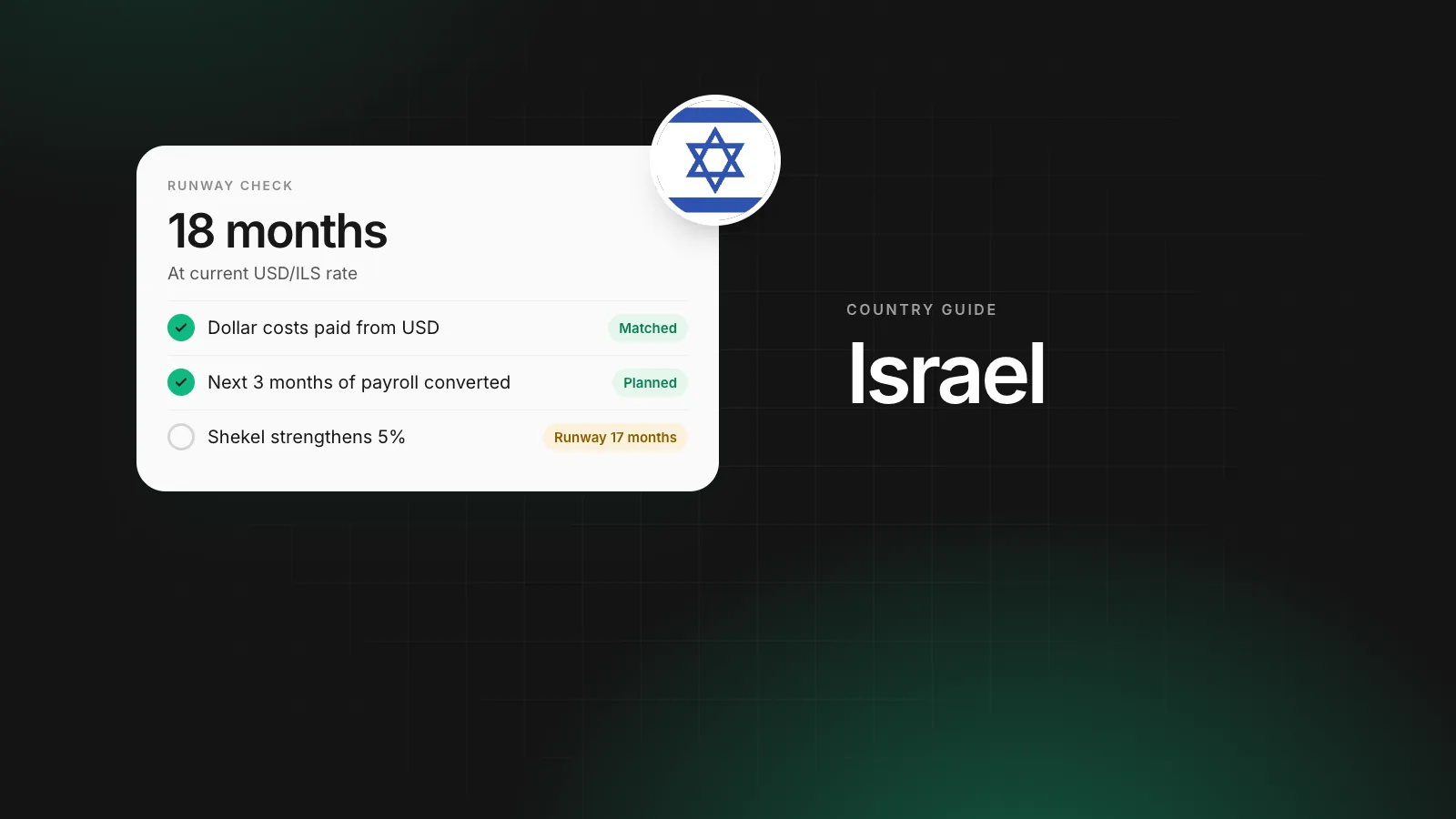
A Herzliya startup raised $12 million and has 40 engineers in Israel. At the rate on the day it closed the round, its runway was 20 months. Over the next six months the shekel strengthened by about 6 percent. Same team, same plan; runway fell by more than a month.
Why it happens
Israeli startups usually raise in dollars from US and international investors and sell to customers in dollars. Their largest costs, salaries, rent, Israeli taxes and social security, are in shekels. The shekel floats, and it has moved substantially in both directions in recent years.
Measure it
Runway in months equals dollar cash divided by monthly burn in dollars. Burn in dollars equals shekel costs divided by the exchange rate plus dollar costs. Run the calculation at today's rate and at a rate 5 and 10 percent stronger for the shekel. The difference is your exposure in months.
Reduce it
- Match dollar costs. Cloud, software, US staff and travel paid from the dollar balance carry no shekel risk.
- Convert in planned amounts. Many startups convert three to six months of shekel payroll at a time, fixing part of the runway, and hold the rest in dollars.
- Use forwards later. Larger companies with bank credit lines can fix rates for longer with forwards.
Be deliberate
There is no right rate to convert at. The point is that conversions become decisions on a schedule, and the board sees the effect of currency moves on runway explicitly.
Where Rivet fits
A Rivet business account accepts registered companies after verification, including Israeli companies and US entities of Israeli startups. Approved companies get US account details in their own name on every plan, euro and sterling details from the Growth plan, and on Scale balances in 30 currencies. Dollars can be held, spent with Visa company cards or converted at a rate shown before you confirm. Rivet is not a bank; regulated partner institutions hold the funds.
Questions people ask
Why does the shekel matter so much for startups?
Because funding and revenue are in dollars, while salaries, rent and Israeli taxes are in shekels. Exchange rate moves change runway directly.
Should startups convert all funding into shekels?
Rarely. Converting everything at once fixes one rate but removes flexibility. Many convert a set number of months of payroll ahead and hold the rest in dollars.
Can Israeli companies hold dollars?
Yes. Israel has no currency controls on companies, and dollar accounts are common.
Do forwards make sense for startups?
For larger, predictable shekel needs, forwards from a bank can fix the rate for months ahead. They require a credit line and fit later-stage companies best.
Sources
Rashidatou writes Rivet's guides to how money moves between countries: the payment rails, what each one costs, and the account details a company needs to get paid in another currency. Every figure in Rashidatou's articles is traced to the scheme rulebook, the regulator or the provider's published price list, and those sources are listed at the end.
More from Rashidatou K. →This article is general information, not legal, tax or financial advice. Rules and fees change; check the sources above and the provider’s current terms before you act on them.
- israel
- startups
- usd revenue
- ils
- currency risk
- runway