Beneficial owners explained: the 25% rule and why every provider asks
Every business account application asks who the beneficial owners are. Here is what that means, how the 25% rule works, and what changed with BOI reports.
- Published
- Reading time
- 2 min read
"Beneficial owner" appears on every business account application, and "beneficial owner meaning" is searched by founders who are not sure whether to list their co-founder, their investor, or their holding company. The rule is about people, not shareholders on paper.
What a beneficial owner is
The individual who ultimately owns or controls a company. If shares are held by another company, a trust or a nominee, the beneficial owners are the real people behind that holder.
The 25% rule
| Jurisdiction | Ownership test | Control test |
|---|---|---|
| US (banks, FinCEN CDD rule) | Each individual owning 25% or more | One individual with significant control, such as the CEO |
| UK (PSC register) | More than 25% of shares or votes | Power to appoint most directors, or significant influence |
| EU (AML rules) | More than 25% | Control through other means |
Some providers ask about owners from 10% for higher-risk cases or countries.
Tracing through holding companies
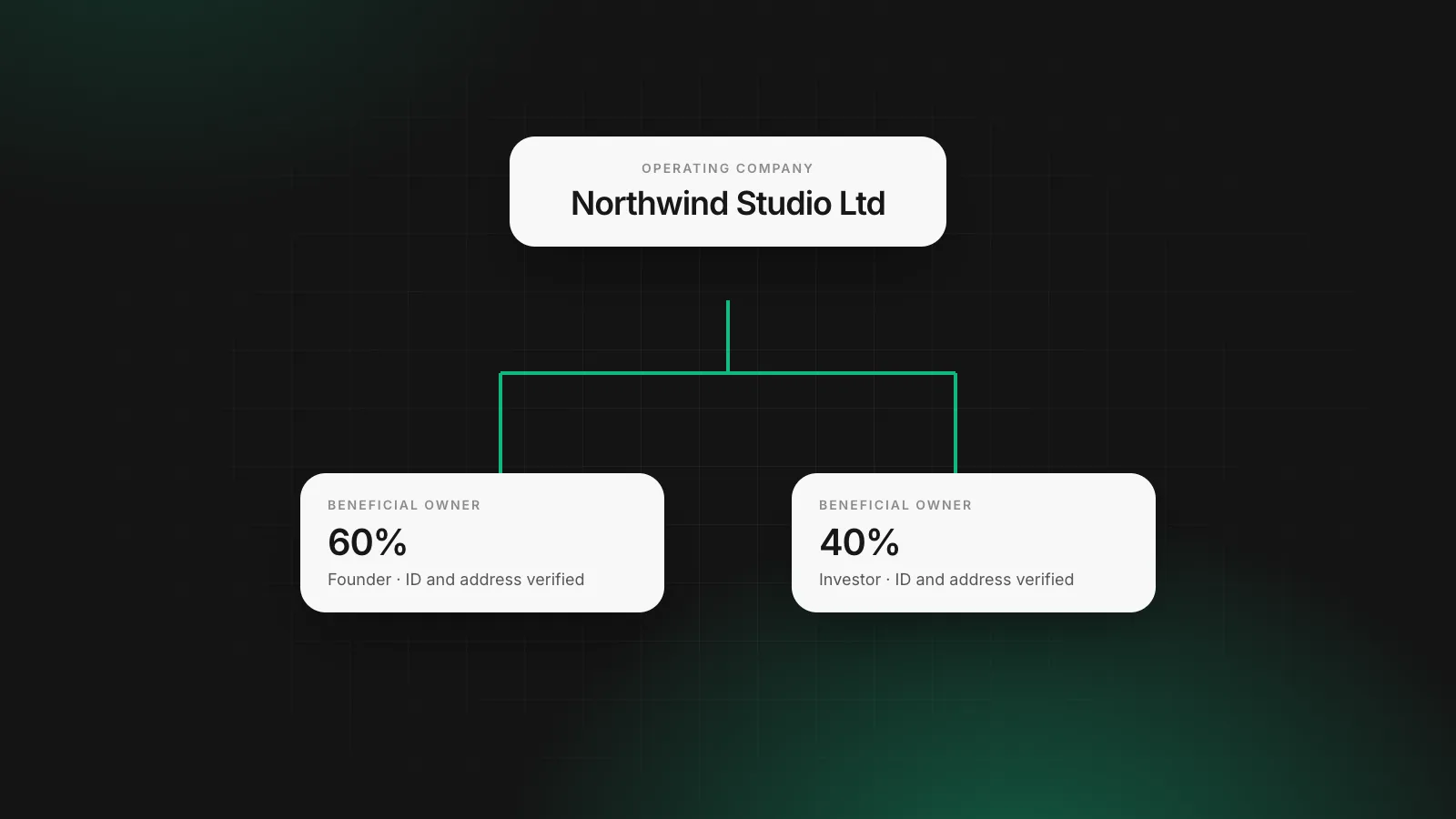
If HoldCo Ltd owns 100% of your operating company, and you own 60% of HoldCo while an investor owns 40%, then:
- You own 60% indirectly: a beneficial owner.
- The investor owns 40% indirectly: also a beneficial owner.
Providers trace every layer to the individuals at the top, so draw the chart before you apply. The KYB vs KYC guide covers what else is checked.
What changed with BOI reports
Under the US Corporate Transparency Act, companies had to file beneficial ownership information (BOI) reports with FinCEN. In March 2025, an interim final rule exempted companies formed in the US. Foreign companies registered to do business in a US state still have obligations, with exemptions for reporting US persons.
That change affected filing with FinCEN, not banking. Every bank and payment provider still identifies and verifies beneficial owners at account opening under the customer due diligence rule.
If no one owns 25%
When ownership is spread, no one may meet the ownership test. The provider then identifies a senior controlling person, such as a director, as the beneficial owner.
On Rivet
Rivet verifies each owner of 25% or more and a controlling person, entirely online, wherever they live in the countries we support. The US LLC guide covers the filings for US companies, and Services explains how onboarding works.
Questions people ask
What does beneficial owner mean?
The individual who ultimately owns or controls a company or receives its benefits. It is about real people, so if a company is owned by another company, the beneficial owners are the people who own that one.
Who counts as a beneficial owner for a bank account?
In the US, each individual who owns 25% or more of the equity, directly or indirectly, and one individual with significant responsibility to control the company, such as the CEO. In the UK and EU, individuals holding more than 25% or controlling the company by other means.
Do I still need to file a BOI report?
Not for a company formed in the US. FinCEN's interim final rule of March 2025 exempted US-formed companies from beneficial ownership reporting. Foreign companies registered to do business in the US still have reporting obligations, with exemptions for US owners. Check FinCEN's current guidance.
What if no one owns 25%?
Then no one meets the ownership test, and the provider identifies the controlling person, such as a director or managing official, as the beneficial owner. Many providers also ask about anyone with 10% or more for higher-risk cases.
Sources
William covers what happens once a company starts moving money: getting the business verified, paying contractors and suppliers abroad, and keeping card spend under control. William writes for the founder or finance lead who has to make it work this week, and links every rule cited to the text it comes from.
More from William Sunjo M. →This article is general information, not legal, tax or financial advice. Rules and fees change; check the sources above and the provider’s current terms before you act on them.
- beneficial owner
- beneficial owner meaning
- beneficial ownership information
- boi report
- 25% rule