Payoneer vs PayPal for business: which costs less to get paid
PayPal is easy for clients and expensive for you once currency is involved. Payoneer is cheaper to receive into but charges to withdraw with conversion. A worked $5,000 invoice shows the gap.
- Published
- Updated
- Reading time
- 2 min read
Google's top suggestion after "payoneer vs" is PayPal. Both let a business abroad get paid by US clients. The costs work very differently. PayPal figures are from its US business fee page and Payoneer's from its pricing page, both read on 1 November 2026.
How each one charges
| PayPal (US business) | Payoneer | |
|---|---|---|
| Receive a business payment | 3.49% + fixed fee | Free into same-currency details |
| International | +1.50% | Not separate |
| Client pays by card | Included in the rate | Up to 3.99% + $0.49 |
| Currency conversion | 3.00% spread | 0.50% between balances |
| Withdraw to a bank | Instant transfer 1.50% (min $0.50) | 1.2% to 4% with conversion |
One invoice, both routes
A US client pays a $5,000 invoice to an agency abroad, which converts it to its local currency.
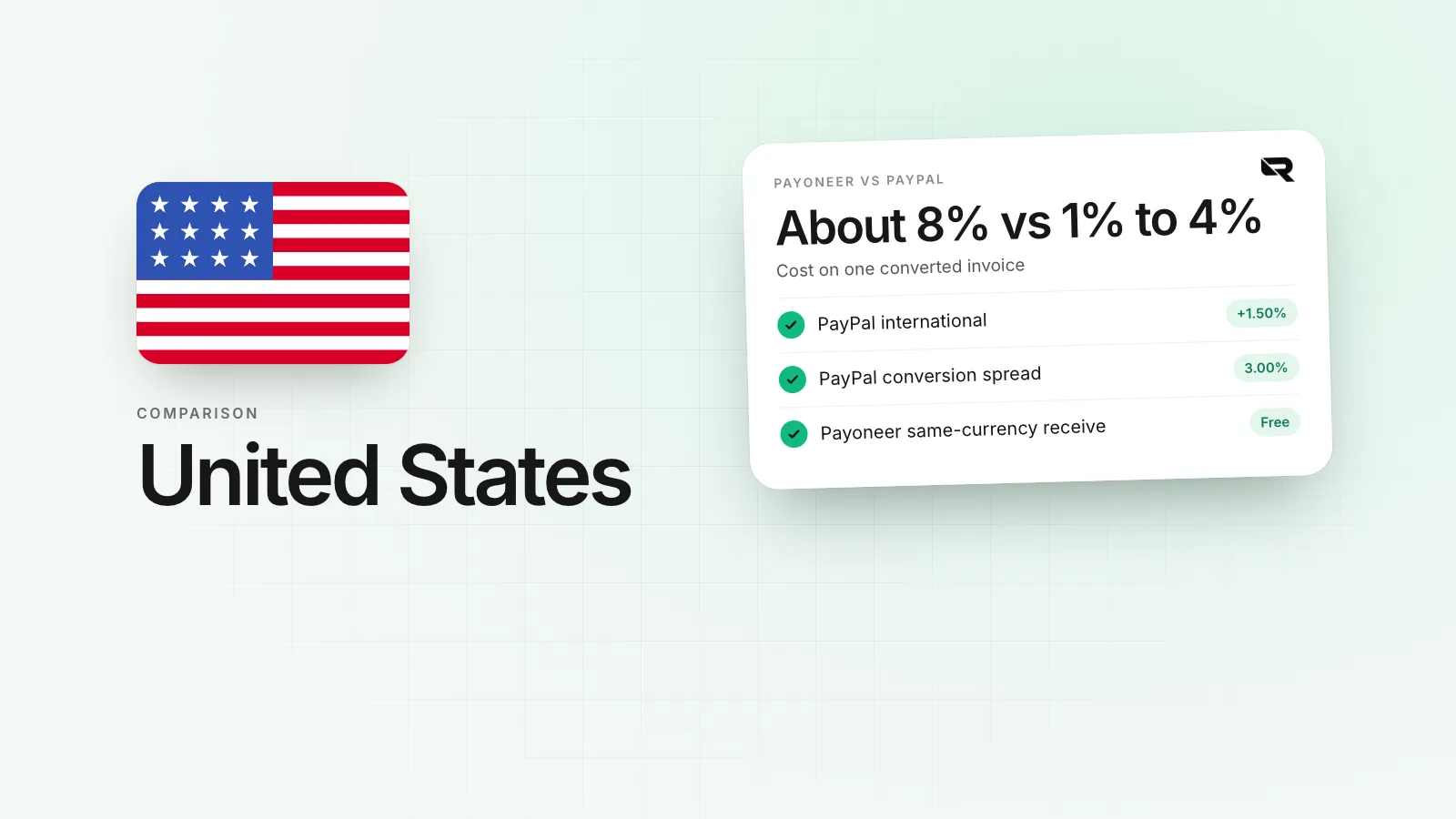
- PayPal: 3.49% is about $175, plus the fixed fee. International adds $75. Conversion at 3.00% on the remainder is about $143. Total roughly $390, close to 8%.
- Payoneer: the client pays by ACH into Payoneer's USD details at no fee. Withdrawing with conversion at 1.2% to 4% costs $60 to $200.
When PayPal still makes sense
For a $200 job from a client who will never set up a bank transfer, PayPal's fee is the price of getting paid at all. For a monthly retainer, the percentage adds up fast.
The cheaper pattern
Ask business clients to pay by bank transfer to account details in your company's name. US clients pay by ACH or wire, European clients by SEPA, UK clients by Faster Payments. You then convert when you choose.
Paying into the United States: the local rail
| What | Detail |
|---|---|
| Local rail | ACH for batch payments; RTP and FedNow for instant transfers |
| Run by | Nacha for ACH; The Clearing House for RTP; the Federal Reserve for FedNow |
| Settlement | Same-day ACH within the business day, standard ACH the next; RTP and FedNow in seconds, 24/7, where both banks take part |
Source: Nacha: Same Day ACH. Checked when this guide was last updated; the scheme's own page has the current figures.
Where Rivet fits
Rivet gives registered companies USD details on the free Starter plan and EUR and GBP details on Growth. There is no percentage fee to receive by bank transfer, and conversion runs from 0.80% to 0.30% by plan, shown before you confirm. Rivet is not a bank; regulated partner institutions hold the funds. See PayPal business fees and Accounts.
Questions people ask
Is Payoneer better than PayPal for receiving money?
For bank transfers from business clients, yes: receiving into Payoneer's same-currency details is free. PayPal charges a percentage on every commercial payment and more for international and converted ones.
What are PayPal's international fees?
PayPal's US page lists an additional 1.50% for international commercial payments and a 3.00% spread above the base rate for currency conversion.
Why do clients prefer PayPal?
It takes one click and no bank details. For small or one-off payments that convenience can be worth the fee.
What is the cheapest way to get paid by a US client?
Give them US account details they can pay by ACH. ACH is cheap or free for the sender and receiver.
Sources
Alexia compares the accounts, cards and payment tools companies weigh before they switch, and writes Rivet's market guides for founders in a specific country. Prices in Alexia's comparisons come from each provider's own pricing page on the date given in the article, rules come from the regulator or tax authority that sets them, and every source is listed at the end.
More from Alexia M. →This article is general information, not legal, tax or financial advice. Rules and fees change; check the sources above and the provider’s current terms before you act on them.
- payoneer vs paypal
- paypal business fees
- payoneer fees
- international payments
- comparison