How to pay contractors in India from the US
Indian contractors usually want rupees in their bank account with the right paperwork for their bank and tax filings. Paying in INR on a local rail is often cheaper than a USD wire.
- Published
- Reading time
- 1 min read
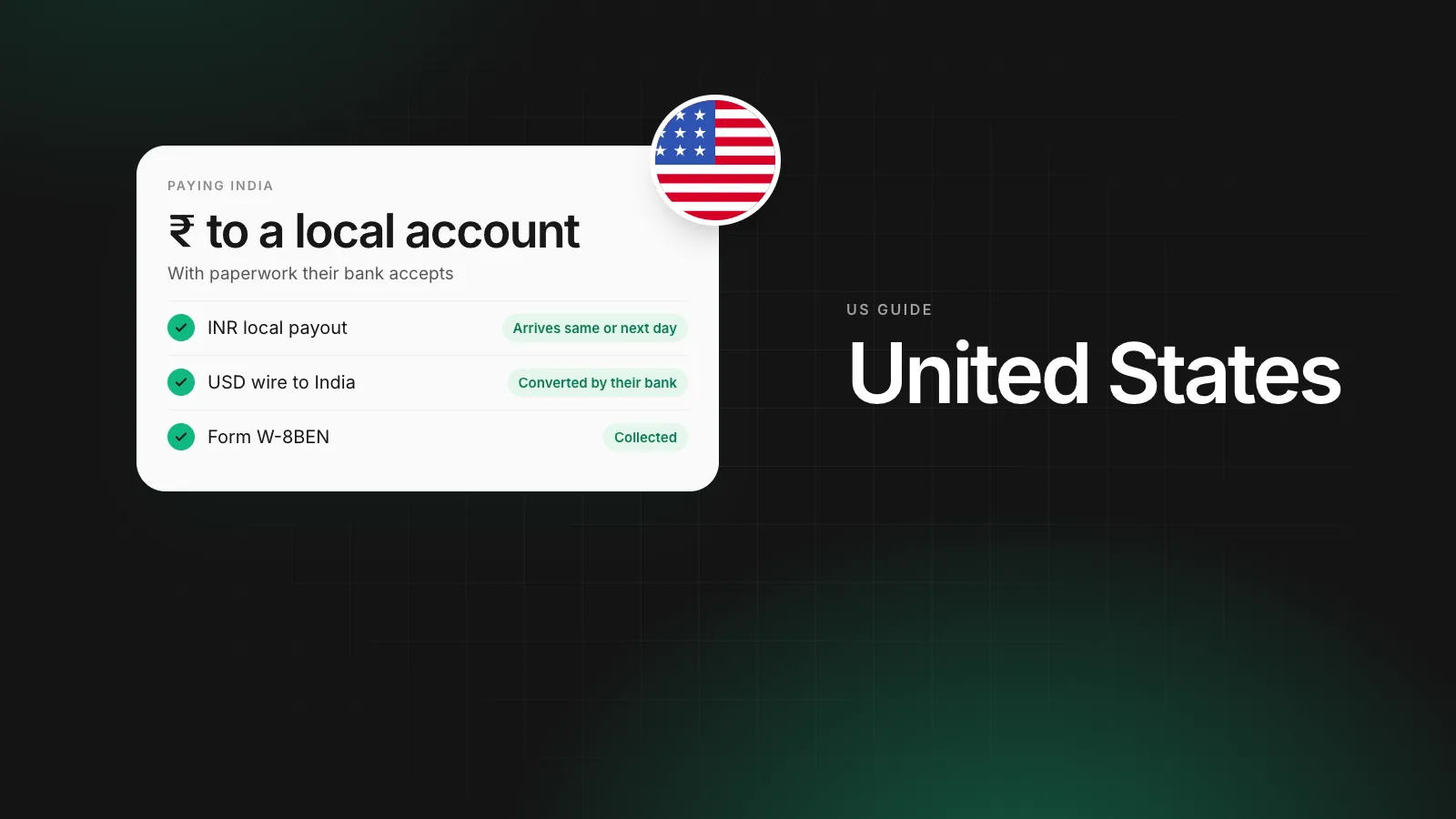
India is one of the largest destinations for US companies' contractor payments: developers, designers, support staff and analysts. The way you pay affects how much they receive and how easily they can prove it to their bank and tax office.
Routes compared
| Route | What the contractor gets | Paperwork |
|---|---|---|
| USD wire to an Indian bank | INR at their bank's rate, minus fees | FIRA from their bank |
| INR local payout | INR at your provider's rate | FIRA or equivalent, depending on the route |
| Platform (marketplace) | Platform fees deducted | Platform statement |
What the contractor needs
- Payment into an account in their own name.
- A clear purpose of payment for their bank.
- A FIRA or equivalent for each receipt.
- Invoices that match the payments, for GST and income tax.
Your side
- Collect a W-8BEN once.
- Pay against their invoice, with the invoice number as the reference.
- Keep receipts.
A $3,000 monthly payment
By USD wire, the contractor's bank converts at its own rate and may deduct fees, so the rupee amount is only known when it lands. By INR payout at a published 0.5% margin with a flat fee, you can check the rate against the RBI reference rate before you send.
Paying into the United States: the local rail
| What | Detail |
|---|---|
| Local rail | ACH for batch payments; RTP and FedNow for instant transfers |
| Run by | Nacha for ACH; The Clearing House for RTP; the Federal Reserve for FedNow |
| Settlement | Same-day ACH within the business day, standard ACH the next; RTP and FedNow in seconds, 24/7, where both banks take part |
Source: Nacha: Same Day ACH. Checked when this guide was last updated; the scheme's own page has the current figures.
Where Rivet fits
Rivet pays contractors in India and 120+ other countries from your USD balance, in local currency on local rails where available, with fee and FX shown before you confirm. Rivet is not a bank; regulated partner institutions hold the funds. See INR business payments.
Questions people ask
What is the cheapest way to pay a contractor in India?
Usually a local INR payout from a provider with a low FX margin. A USD wire leaves conversion to the contractor's bank.
What is a FIRA?
A Foreign Inward Remittance Advice issued by the Indian bank receiving the payment. Contractors use it as evidence of export income.
What purpose code should be used?
The contractor's bank asks for a purpose code describing the service, such as software or consulting. Ask the contractor which one their bank expects.
Do I withhold US tax?
Generally not for services performed entirely outside the US by a non-US person. Collect a W-8BEN.
Sources
Alexia compares the accounts, cards and payment tools companies weigh before they switch, and writes Rivet's market guides for founders in a specific country. Prices in Alexia's comparisons come from each provider's own pricing page on the date given in the article, rules come from the regulator or tax authority that sets them, and every source is listed at the end.
More from Alexia M. →This article is general information, not legal, tax or financial advice. Rules and fees change; check the sources above and the provider’s current terms before you act on them.
- pay contractors in india
- usd to inr
- fira
- purpose code
- gst export
- w-8ben