Panama's territorial tax system: documenting foreign-source income your company receives
Panama taxes companies on income from Panamanian sources, so revenue earned from operations abroad is generally outside the tax. That has made Panama a common base for regional companies. It also makes documentation the thing tax authorities and banks ask about first.
- Published
- Reading time
- 1 min read
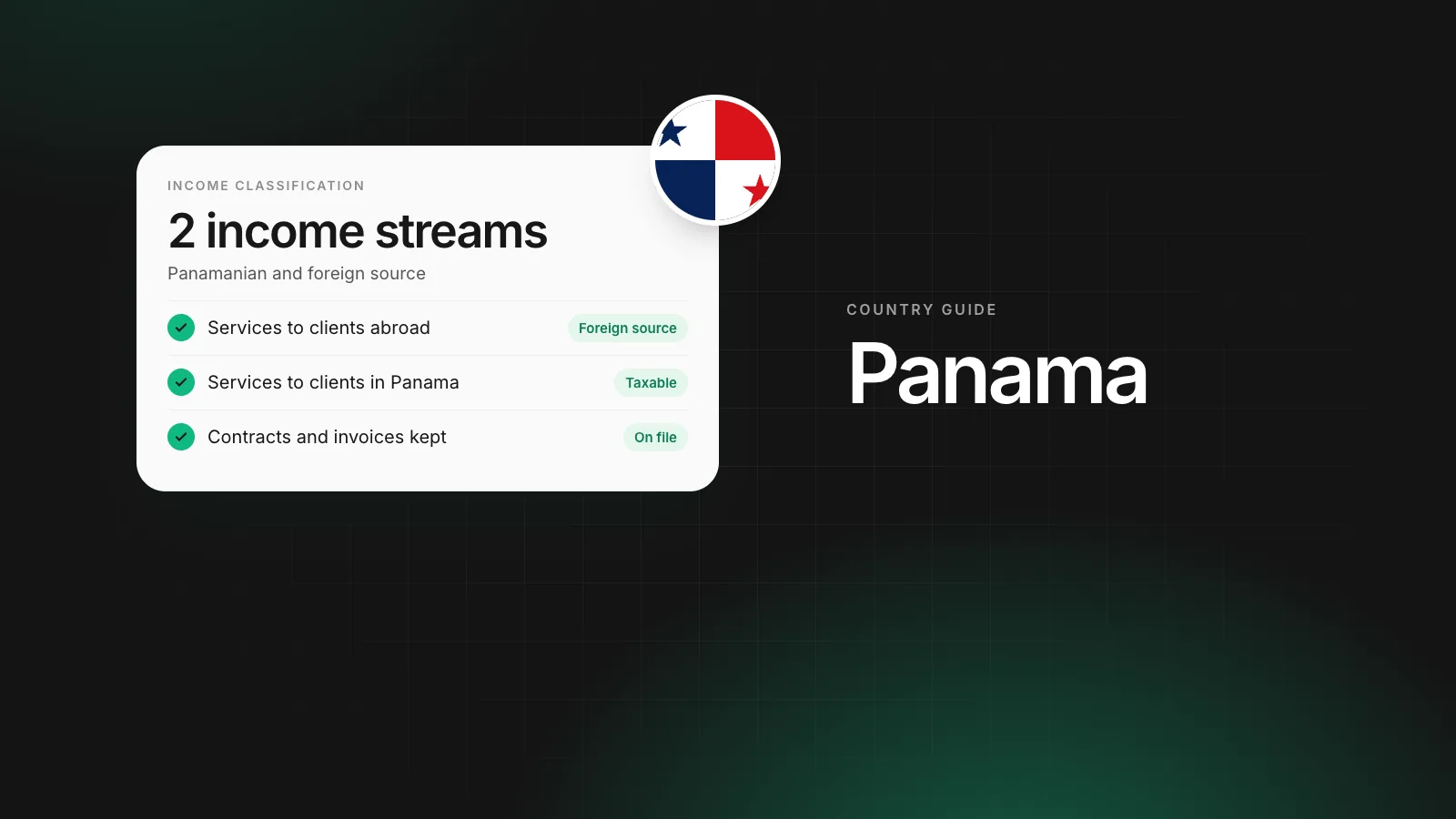
A Panama City consulting company advises clients in Colombia, Guatemala and the US. A small part of its work is for Panamanian clients. Its accountant splits revenue into two lines every month: foreign source, generally outside Panama's income tax, and Panamanian source, taxed. The split is only as good as the documents behind it.
A territorial system
Panama's income tax applies to income from Panamanian sources. Income from activities carried out and consumed abroad is generally foreign source and outside the tax. This territorial principle is a main reason regional companies are based in Panama.
What counts as foreign source depends on the activity. Services delivered to clients abroad, with the work and its effects outside Panama, are the clearer cases. Services delivered to Panamanian clients, or with effects in Panama, are Panamanian source.
Substance rules
Panama's place on EU tax lists in recent years led it to introduce rules on foreign-source passive income, such as dividends, interest and royalties, for certain entities, requiring economic substance in Panama to keep such income untaxed. Companies with passive foreign income should check whether these rules apply.
Documents that support the split
Keep, for each client:
- The contract, showing the client's location and where the service is delivered.
- Invoices, with the client's foreign details.
- Payment records, showing where the money came from.
Tax audits and bank reviews both start with these.
Banks ask the same questions
Banks and their correspondents need to understand a company's sources of funds. A Panamanian company receiving payments from several countries will be asked who its clients are and why they pay. The documents above answer that too.
Where Rivet fits
A Rivet business account accepts registered companies after verification, including Panamanian companies. Approved companies get US account details in their own name on every plan and euro and sterling details from the Growth plan. Each payment is matched to its invoice, which keeps the record of who paid and for what in one place. Rivet is not a bank; regulated partner institutions hold the funds.
Questions people ask
Does Panama tax foreign income?
Panama's income tax is territorial: it generally applies only to income from Panamanian sources. Income from activities carried out abroad is generally outside it.
What is foreign-source income in Panama?
Broadly, income from transactions carried out, completed or with effects outside Panama. The specifics depend on the activity, so take advice.
Do substance rules apply?
Panama introduced rules on foreign-source passive income for some entities, requiring economic substance to keep it untaxed. They respond to EU tax lists. Check whether your company is affected.
Why do banks ask about foreign income?
Banks and correspondent banks need to understand where a company's money comes from and why. Clear documents answer those questions quickly.
Sources
William covers what happens once a company starts moving money: getting the business verified, paying contractors and suppliers abroad, and keeping card spend under control. William writes for the founder or finance lead who has to make it work this week, and links every rule cited to the text it comes from.
More from William Sunjo M. →This article is general information, not legal, tax or financial advice. Rules and fees change; check the sources above and the provider’s current terms before you act on them.
- panama
- territorial tax
- foreign-source income
- dgi
- substance
- compliance