Hungary's real-time invoice reporting and foreign clients: what NAV Online Számla covers
Hungarian companies report every invoice to the tax authority in close to real time through NAV Online Számla. Since 2021 that includes invoices to foreign businesses and to consumers. Exporters often discover this when NAV asks about a missing export invoice.
- Published
- Reading time
- 2 min read
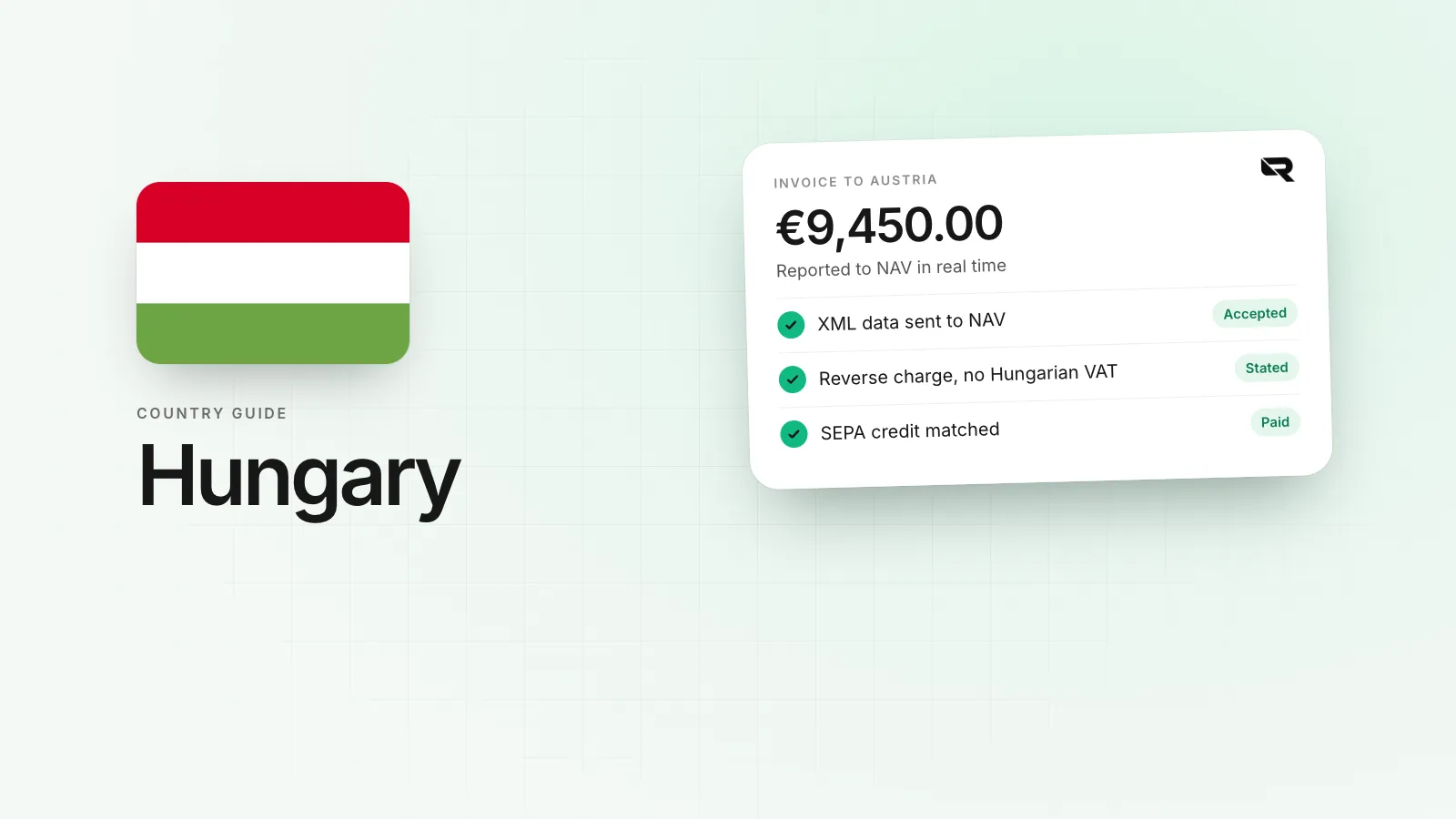
A Győr automotive parts supplier invoices an Austrian buyer in euros. Its invoicing software sends the invoice data to NAV, the Hungarian tax authority, within seconds of issue. A PDF goes to Austria. If the software had not sent the data, NAV would see a gap between the company's VAT return and its reported invoices, and the first question would come by letter.
Real-time reporting, not e-invoicing
Hungary does not (yet) require a structured e-invoice to be exchanged between companies. It requires something else: every invoice's data is reported to NAV through the Online Számla system, in close to real time. The invoice sent to the customer can be a PDF or paper.
The rules have widened in stages. Since 4 January 2021 they cover:
- invoices to Hungarian businesses,
- invoices to private individuals,
- invoices to foreign businesses, including intra-EU and export transactions.
What the software does
Invoicing software connected to NAV transmits the data in a set XML format automatically on issue, and receives confirmation. If you issue invoices manually, deadlines for entering the data are short. Choose software that handles foreign customer details, foreign VAT numbers and currencies properly; validation errors on foreign invoices are common.
VAT wording for foreign clients
For most services and intra-EU supplies of goods to EU businesses, the invoice shows no Hungarian VAT, includes both VAT numbers and states the reverse charge (fordított adózás). Intra-EU sales also go in the recapitulative statement. Services to non-EU businesses state that they are not taxable in Hungary.
Euro invoices and forint books
Many Hungarian exporters invoice in euros. Where VAT appears, its amount must also be shown in forints. Books are kept in forints, converted at the MNB rate or another rate the law allows, applied consistently.
Getting paid
Hungary is in the SEPA area, so an Austrian buyer can pay euros to a Hungarian IBAN by SEPA. If the account is in forints, the bank converts on arrival at its own rate. Holding euros lets you pay euro costs directly and convert only what you need in forints.
Paying into Hungary: the local rail
| What | Detail |
|---|---|
| Local rail | Azonnali fizetés (AFR instant payments) |
| Run by | GIRO Zrt., owned by the Magyar Nemzeti Bank |
| Settlement | Within five seconds, 24/7; domestic forint transfers below the scheme threshold must go this way |
Source: GIRO Zrt.: instant payment system. Checked when this guide was last updated; the scheme's own page has the current figures.
Where Rivet fits
Rivet does not report invoices to NAV; your invoicing software does that. A Rivet business account handles the collection side: euro details with an IBAN and sterling details from the Growth plan, US dollar details on every plan, and balances in 30 currencies, forints included, on the Scale plan. Payments are matched to invoices and conversions happen at a rate shown before you confirm. Rivet is not a bank; regulated partner institutions hold the funds.
Questions people ask
Do invoices to foreign clients have to be reported to NAV?
Yes. Since 4 January 2021 the reporting obligation covers invoices to foreign businesses and to private individuals, not only domestic B2B invoices.
When must the data reach NAV?
Invoicing software must send the data automatically and without delay on issue. Manually issued invoices have short deadlines.
Can a Hungarian company invoice in euros?
Yes. Where VAT appears, the VAT amount must also be shown in forints, converted at the rate the law allows, usually the MNB rate.
Is NAV Online Számla an e-invoicing mandate?
It is a reporting obligation. The invoice itself can be paper or PDF; the data goes to NAV in a set XML format.
Sources
William covers what happens once a company starts moving money: getting the business verified, paying contractors and suppliers abroad, and keeping card spend under control. William writes for the founder or finance lead who has to make it work this week, and links every rule cited to the text it comes from.
More from William Sunjo M. →This article is general information, not legal, tax or financial advice. Rules and fees change; check the sources above and the provider’s current terms before you act on them.
- hungary
- nav online számla
- rtir
- vat
- exports
- huf