Chilean companies paying foreign providers: impuesto adicional and treaty relief
A Chilean company paying a US consultant or a Spanish software developer may have to withhold impuesto adicional before the payment leaves. The rate depends on the service and the provider's country, and treaties often reduce it.
- Published
- Reading time
- 2 min read
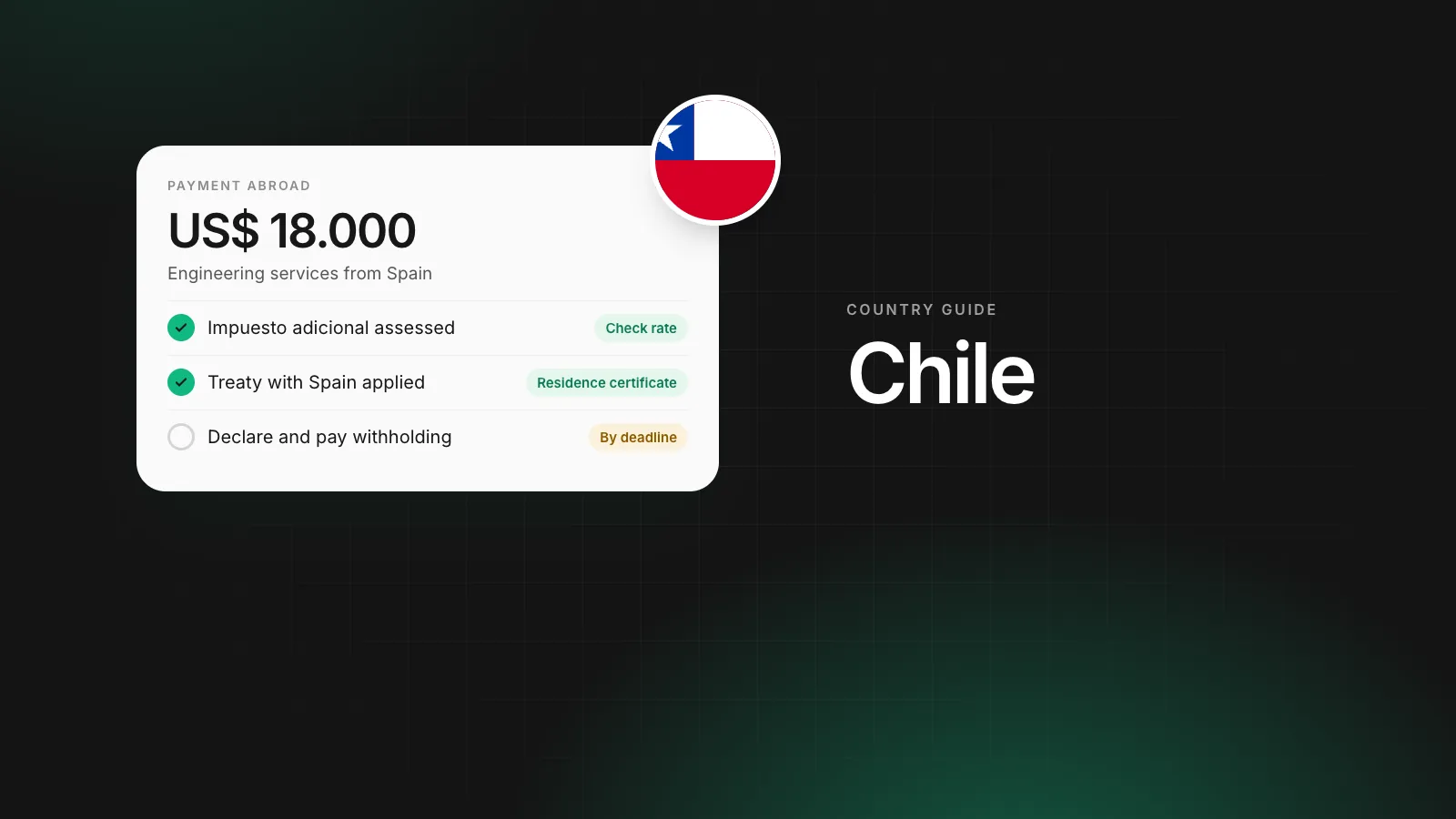
A Valparaíso port logistics company hires a Madrid engineering firm for US$18,000 to redesign its warehouse systems. Its finance team plans a simple transfer. The accountant stops it: the payment may be subject to impuesto adicional, Chile's withholding tax on payments to non-residents, and the company has to withhold, declare and pay it before or as the money leaves.
What impuesto adicional covers
Impuesto adicional applies to Chilean-source income paid to non-residents. For companies buying from abroad, the most common cases are:
- royalties for software, trademarks and know-how,
- interest on foreign loans,
- many services, including technical and professional services.
Whether a service is affected can depend on where it is performed and how it is used. Some services performed entirely abroad are treated differently. The law and SII rulings are detailed, so check each new type of payment.
Rates
The general rate is 35 percent. Several categories carry reduced rates; certain technical and professional services, for example, are commonly subject to 15 percent, with higher rates when the provider is in a listed low-tax jurisdiction. Royalties have their own rates.
Treaties
Chile has tax treaties with many countries, including Spain, Mexico, Canada, the UK and others. A treaty can reduce or eliminate impuesto adicional on certain payments. To apply it:
- Obtain the provider's certificate of tax residence from its tax authority.
- Obtain any sworn declaration the SII requires.
- Keep both on file before the payment is made.
The payer is responsible
The Chilean company withholds the tax, declares it and pays it to the SII. If it does not, the SII can collect the tax from the Chilean company. Foreign providers often quote net amounts, so agree who bears the tax before you sign.
Making the payment
Once the tax position is clear, payments abroad are made through banks or payment providers, which may ask for the invoice and contract. Operations above certain thresholds are reported under the Central Bank's international exchange rules.
Paying into Chile: the local rail
| What | Detail |
|---|---|
| Local rail | Transferencias electrónicas de fondos (TEF) |
| Run by | Centro de Compensación Automatizado (CCA) |
| Settlement | Seconds for transfers between participating banks |
Source: CCA Chile. Checked when this guide was last updated; the scheme's own page has the current figures.
Where Rivet fits
Rivet does not calculate or pay Chilean withholding. A Rivet business account accepts registered companies after verification, including Chilean companies, and pays providers in 120+ countries from dollar and other balances, with each payment matched to its invoice and its rate shown before you confirm. Rivet is not a bank; regulated partner institutions hold the funds.
Questions people ask
Which payments to foreign providers carry impuesto adicional?
Royalties, interest, and many services, including technical and professional services, can be subject to it. Some services performed entirely abroad may be treated differently. Check each type with your accountant.
What rates apply?
The general rate is 35 percent, with reduced rates for some services, such as 15 percent for certain technical and professional services, and higher rates in specific cases. Treaties can lower them.
How do I apply a treaty?
Obtain the provider's certificate of tax residence from its country, and any declarations the SII requires, before payment. Keep them on file.
Who pays if the tax is not withheld?
The Chilean payer is responsible for withholding and paying the tax. If it fails, the SII can collect it from the payer.
Sources
Rashidatou writes Rivet's guides to how money moves between countries: the payment rails, what each one costs, and the account details a company needs to get paid in another currency. Every figure in Rashidatou's articles is traced to the scheme rulebook, the regulator or the provider's published price list, and those sources are listed at the end.
More from Rashidatou K. →This article is general information, not legal, tax or financial advice. Rules and fees change; check the sources above and the provider’s current terms before you act on them.
- chile
- impuesto adicional
- withholding
- foreign providers
- tax treaties
- payments